IPTV for Developers and Tech Enthusiasts: Build the Ultimate Live Sports Streaming Setup in the US
If you spend your days optimizing build pipelines, tuning network throughput, or debugging latency spikes, there is something deeply satisfying about applying that same engineering mindset to your entertainment stack. Most cable subscriptions are the equivalent of legacy monolith code: bloated, overpriced, locked behind long-term contracts, and impossible to refactor. IPTV — Internet Protocol Television — is the microservices architecture of television. It streams channels over your existing broadband connection, delivers them on demand, and gives you granular control over quality, hardware, and cost.
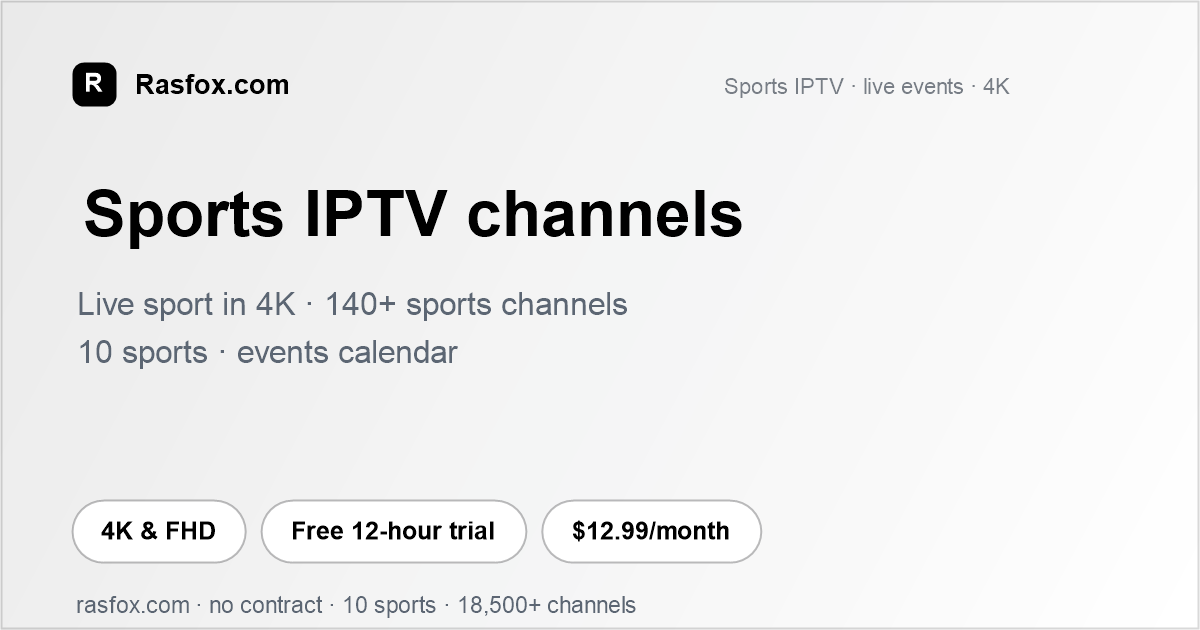
For developers, sysadmins, homelab builders, and general tech enthusiasts in the United States, IPTV is not just a cheaper cable alternative. It is a configurable system — and when it is built with a total focus on sports channels and live sports events, it becomes the highest-performance piece of media infrastructure in your home. In this guide, we will break down how IPTV works under the hood, how to architect your setup, how to stay on the right side of the law, and why sports-first providers such as RasFox IPTV have become the default choice for viewers who refuse to accept buffering.
What Is IPTV and Why It Outperforms Traditional Cable for Live Sports
IPTV delivers television content as data packets over your internet connection rather than through coax cable, satellite dishes, or terrestrial antennas. Instead of a single broadcast stream being pushed to every household in a region, an IPTV provider serves a unicast or multicast stream directly to your device on request.
The engineering consequences are significant:
- Adaptive bitrate streaming. Modern IPTV platforms adjust resolution on the fly based on real-time bandwidth, so a momentary network hiccup does not turn a penalty shootout into a slideshow.
- Device agnosticism. The "client" can be a Smart TV, an Android box, a Fire Stick, an iOS device, a Windows PC, or an LG webOS panel. Same stream, many endpoints.
- Zero hardware lock-in. No proprietary set-top box with a two-year rental fee attached to your account.
- VOD alongside linear TV. A well-built service pairs live channels with a large on-demand library, so you can watch the match live and the post-game analysis later.
Why sports fans feel the difference first
Sports content is the ultimate stress test for any streaming stack. It is live, it is unpredictable, and it punishes both latency and packet loss. A 200 ms delay is invisible in a movie but audible when your neighbor's cheer reaches you before the goal does. A single dropped burst during a Champions League knockout round is unforgettable.
That is why a sports-first IPTV architecture matters. Providers engineered around live events invest in higher-bitrate feeds — 4K at 50FPS, for example — plus redundant source routing and stable CDN peering. Providers that treat sports as an afterthought do not.
How IPTV Fits Into a Modern Tech-Driven Smart Home
Here is where the thematic bridge sits for anyone running a connected home: IPTV is not a separate appliance, it is an endpoint in your existing network topology. If you already automate lights, monitor your NAS, and segment your Wi-Fi into VLANs, adding IPTV is a configuration task, not a purchase decision.
Consider what happens when you treat streaming like any other service on your LAN:
- QoS rules on your router can prioritize the IPTV client's MAC address during match hours so that a background backup job never competes with a live feed.
- A dedicated 5 GHz or Wi-Fi 6 SSID for streaming devices eliminates the congestion caused by dozens of IoT sensors chattering on the 2.4 GHz band.
- Multi-screen support means the same subscription can feed your living-room TV and a second display in your home office or workshop — practical when you want the game on one monitor and your IDE on the other.
- EPG and favourites lists function like saved filters: pin the leagues you care about and ignore the rest of the channel universe.
For homelab enthusiasts who want a managed, ready-to-deploy solution rather than another weekend project, a dedicated IPTV subscription built for live sports removes the trial-and-error phase entirely. You plug in credentials, load the M3U or Xtream Codes playlist, and the system runs.
Deep Dive: The IPTV Sports Landscape for US and Worldwide Viewers
The United States is one of the most fragmented sports markets on earth. A single household may need a regional sports network, a national broadcaster, a premium cable tier, and two separate streaming services just to follow one team across a season. IPTV collapses that stack into one interface and one bill.
The sports-first philosophy behind RasFox
RasFox IPTV has an unusual origin story for a streaming provider. Its roots trace back to Radio Malena 89.1 FM, broadcasting from Venezuela 370 in Buenos Aires, Argentina — a station steeped in tango, Argentine cultural tradition, and decades of grassroots sports commentary. That radio heritage shaped the product's DNA: live events come first, commentary and atmosphere matter, and latency is the enemy.
Today the platform carries that tradition into the streaming era, serving lusophone and Latino communities worldwide while remaining fully accessible to English-speaking viewers in the US who want global sports coverage. The result is a catalogue weighted heavily toward live sport rather than filler channels.
What is actually in the channel list
Depending on your region of interest, the sports line-up is deep. Global feeds include ESPN, DAZN, Fox Sports, beIN Sports, Sky Sports, and Eurosport. Viewers following Brazilian football get Globo, SporTV, Premiere, ESPN Brasil, BandSports, Combate, and TNT Sports BR. Portuguese expats and fans of the Primeira Liga get Sport TV 1–6, Eleven Sports, Benfica TV, Porto Canal, DAZN Portugal, and Eurosport. For Argentine and broader Latino coverage, the platform carries TyC Sports, ESPN Premium, TNT Sports Argentina, Fox Sports, and DirecTV Sports. African viewers are covered through SuperSport, Sport TV Africa, and ESPN Africa.
Competition coverage spans the Champions League, Premier League, La Liga, Brasileirão, Copa Libertadores, Liga Portugal, and Liga Argentina, plus Formula 1, UFC, NBA, NFL, and tennis majors.
The headline numbers that matter for a technical audience:
- 12,000+ live channels across sports, news, and entertainment
- 40,000+ VOD titles, with premium sports streams delivered in 4K at 50FPS
- 2 simultaneous screens per subscription
- No buffering on properly provisioned connections
- No contract — month-to-month, cancel whenever
- 24-hour free trial so you can benchmark it before committing
- Portuguese and Spanish support available around the clock
For an engineer, that last point is the honest one: a 24-hour free IPTV trial is the only meaningful benchmark. Run it during a live match, monitor your throughput, and judge for yourself.
Hardware and Setup Guide: Architecting Your Streaming Rig
IPTV is hardware-light, which is part of its appeal. You almost certainly own everything you need already.
Minimum viable setup
- Internet: 25 Mbps is comfortable for 4K single-stream; 50 Mbps or more if you plan to run two screens simultaneously.
- Client device: Amazon Fire TV Stick 4K, Android TV box, NVIDIA Shield, Apple TV, Smart TV with an IPTV player app, or simply a PC running VLC or a dedicated player such as TiviMate, IPTV Smarters, or OTT Navigator.
- Connection: Ethernet where possible. If you must go wireless, use the 5 GHz band and keep the access point in line of sight.
Recommended configuration for power users
- Assign a static DHCP lease to your streaming device so QoS rules survive reboots.
- Test your real-world jitter and packet loss, not just raw download speed. Live sports is sensitive to both.
- Keep a second player app installed as a fallback. Different players handle HLS and MPEG-TS streams differently, and a stream that stutters in one may run perfectly in another.
- Use a wired backhaul for any mesh node serving a TV.
If you would rather skip the manual configuration of playlists and EPG sources, a managed sports-focused IPTV plan with pre-built playlists is the pragmatic route. Setup takes minutes rather than evenings.
Legal vs Illegal IPTV: Safety and Best Practices
This is the section most articles gloss over, and it deserves precision.
IPTV technology itself is completely legal. It is the same delivery mechanism used by legitimate OTT platforms, telecom operators, and public broadcasters. The legal question is never about the protocol — it is about licensing.
A legal IPTV service holds distribution rights or reseller agreements for the content it carries, operates transparently, publishes terms of service, offers identifiable customer support, and processes payments through traceable channels. An illegal service typically offers implausibly low lifetime pricing, no verifiable corporate identity, no support channel, and payment exclusively via cryptocurrency or gift cards.
A practical checklist before you subscribe
- Does the provider have a real website with published terms and a working support channel?
- Is there a free trial that lets you verify stream stability and channel authenticity?
- Are prices realistic for the infrastructure required to deliver 4K 50FPS live sports?
- Is customer support reachable before you pay, not just after?
For readers who want to skip the due diligence rabbit hole, the best IPTV service for live sports and global channels is the one that survives all four checks — and a 24-hour trial exists precisely so that verification happens on your network, with your hardware, during a real match.
Security hygiene that applies regardless of provider
Use a reputable DNS resolver. Isolate streaming devices on a guest network if you want defence in depth. Never share account credentials across more screens than your plan permits — most providers, including RasFox, enforce a two-screen limit, and exceeding it is the fastest way to get a stream throttled.
Frequently Asked Questions
Is IPTV legal in the United States?
Yes. IPTV is a delivery technology, and it is legal. What can be illegal is streaming content that the provider does not hold distribution rights for. Always choose a provider with transparent terms, verifiable support, and realistic pricing.
How much internet speed do I need for 4K live sports?
Around 25 Mbps of stable throughput for a single 4K stream, and 50 Mbps or more if you intend to run two simultaneous screens. Jitter and packet loss matter as much as raw speed for live events.
Can I watch two different matches at the same time?
Yes. RasFox IPTV supports two simultaneous screens per subscription, so you can run a Premier League fixture on the main TV and a Brasileirão match on a second device.
Do I need a special box or antenna?
No. A Fire TV Stick, Android TV box, Apple TV, Smart TV app, or even a PC will work. There is no dish, no antenna, and no proprietary hardware rental.
Is there a way to test the service before paying?
Yes. A free 24-hour trial is available, which is the most reliable way to benchmark stream quality and stability on your own connection during live sports.
Is there a contract or cancellation fee?
No. Plans are prepaid and contract-free, so you can stop whenever you like without penalties.
Conclusion: Treat Your Entertainment Stack Like Your Infrastructure
You would not run production workloads on an unmonitored, overpriced legacy system — yet millions of households still do exactly that with cable. IPTV replaces that monolith with something modular, measurable, and dramatically cheaper, and when the provider is built around live sport first, the performance difference is immediately visible.
With 12,000+ channels, 40,000+ VOD titles in 4K 50FPS, two simultaneous screens, no contract, and no buffering on a properly provisioned connection, RasFox IPTV delivers the kind of setup tech-minded viewers expect: configurable, reliable, and honest about what it does. The heritage runs from Radio Malena 89.1 FM in Buenos Aires to a global sports-first streaming platform — and the free 24-hour trial means you can audit it yourself before you commit a single dollar.
Ready to benchmark it? Start your free 24-hour IPTV trial and explore 4K sports channels today, and watch your next match the way your network was built to deliver it.
About Nvision.dev: we design and engineer immersive interfaces — from AI copilots and data dashboards to WebGL storytelling and design systems. This article is part of our Insights lab where we share experiments, benchmarks and production notes.